


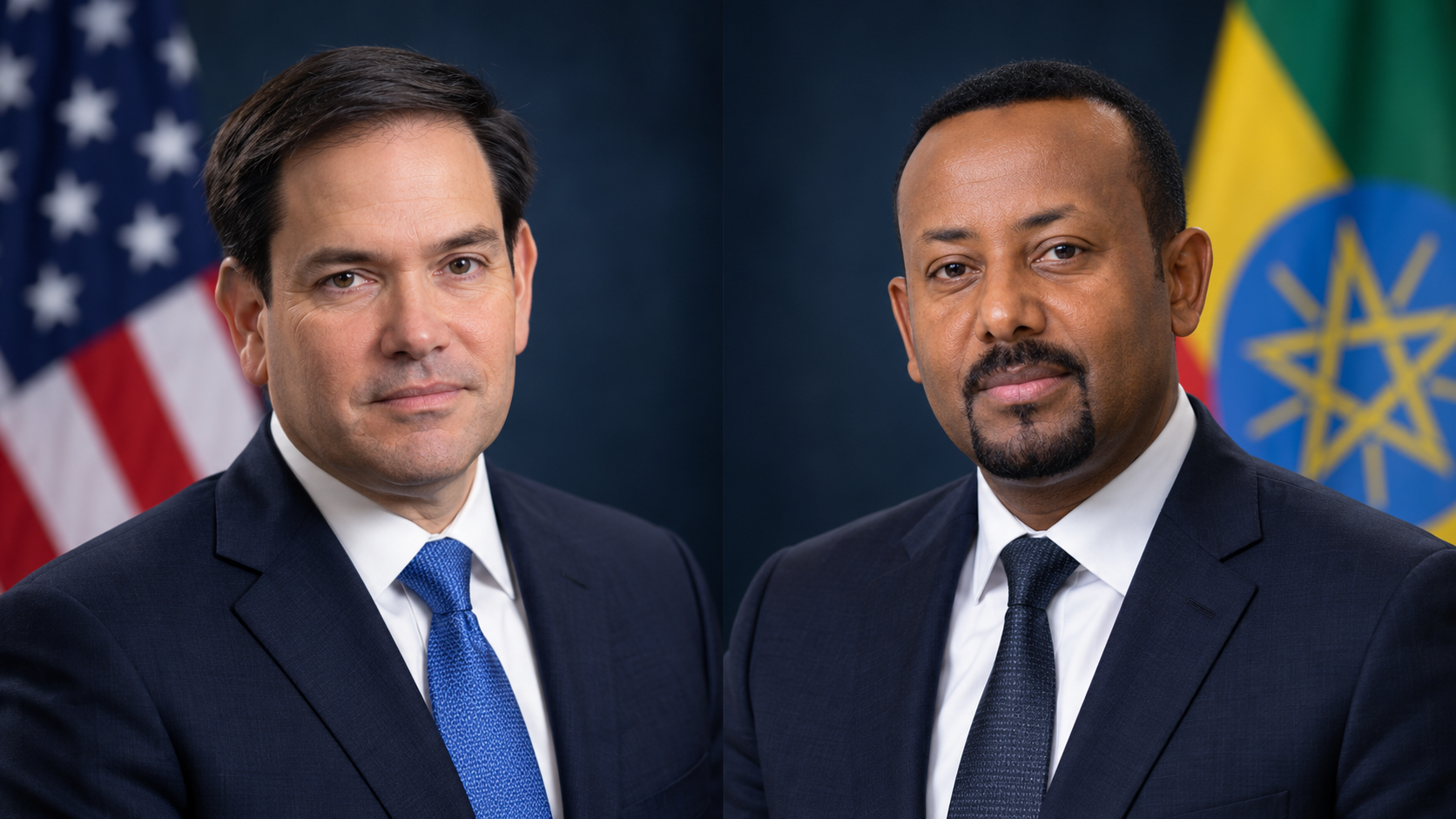
Washington intervenes as Ethiopia–Eritrea tensions rise: Rubio urges restraint amid fears of another regional war.
US Secretary of State Marco Rubio has spoken with Ethiopian Prime Minister Abiy Ahmed as renewed fighting in Tigray and growing tensions between Ethiopia and Eritrea raise fears of another devastating conflict in the Horn of Africa. Washington is calling for restraint and dialogue, but the deepening mistrust between Addis Ababa and Asmara threatens to undermine years of fragile diplomatic progress.
The Horn of Africa is once again confronting the possibility of a dangerous regional confrontation, and Washington is paying attention.
US Secretary of State Marco Rubio has held discussions with Ethiopian Prime Minister Abiy Ahmed as relations between Ethiopia and neighbouring Eritrea deteriorate amid renewed violence in the northern Ethiopian region of Tigray.
The diplomatic exchange comes at a sensitive moment for a region that has already endured decades of conflict, displacement and economic disruption. The prospect of renewed hostilities between Ethiopia and Eritrea carries consequences far beyond their shared border, potentially affecting trade routes, regional security and the stability of the wider Red Sea corridor.
According to the public accounts of the conversation, Washington emphasised the importance of regional security, restraint and dialogue. Prime Minister Abiy, meanwhile, highlighted Ethiopia’s interest in strengthening relations with the United States and developing a more strategic and practical partnership.
The differences in emphasis are significant. Washington’s message focused on preventing escalation, while Addis Ababa presented the conversation as an opportunity to deepen bilateral cooperation.
Neither side announced a ceasefire, formal negotiations or a new security agreement.
Nevertheless, the intervention illustrates growing international concern that tensions between two countries with a complicated history of war and reconciliation could once again threaten the stability of the Horn of Africa.
From historic reconciliation to renewed confrontation
Relations between Ethiopia and Eritrea have undergone extraordinary changes over the past three decades.
The two countries fought a devastating border war between 1998 and 2000, leaving tens of thousands dead and creating a political and military confrontation that persisted long after the fighting stopped.
For nearly two decades, their shared border became a symbol of unresolved hostility.
That situation changed dramatically in 2018, when Ethiopian Prime Minister Abiy Ahmed and Eritrean President Isaias Afwerki announced a historic rapprochement, restoring diplomatic relations and raising hopes for a new era of regional cooperation.
The reconciliation generated considerable optimism. Families separated by the border were briefly reunited, diplomatic contacts resumed and the possibility of closer economic relations appeared within reach.
However, the subsequent conflict in Tigray profoundly complicated relations between Addis Ababa, Asmara and the Tigrayan authorities.
Eritrean forces participated in the Tigray conflict, and the aftermath of that war left unresolved political and security questions. The 2022 Pretoria agreement between Ethiopia’s federal government and Tigrayan representatives ended the principal phase of that conflict, but did not settle every dispute affecting northern Ethiopia.
Today, the renewed violence in Tigray and the increasingly hostile exchanges between Ethiopia and Eritrea have raised questions about the durability of the 2018 reconciliation.
Addis Ababa has accused Eritrean forces of entering and occupying Ethiopian territory. Asmara rejects Ethiopia’s account and has accused its neighbour of threatening military confrontation.
These accusations remain contested, and independent verification of reported troop movements is limited.
What is clear is that the deterioration in relations has created an increasingly uncertain security environment.
Tigray’s fragile peace faces another serious test
The immediate concern is northern Ethiopia, where renewed fighting has threatened the peace established by the Pretoria agreement in November 2022.
Recent developments have demonstrated how quickly the situation can change. Ethiopian government-allied forces entered Mekelle, Tigray’s regional capital, after Tigrayan fighters withdrew. Ethiopian Airlines subsequently resumed flights to the city, offering a limited indication that some normal activities were returning.
Along the Eritrean border, Ethiopian forces also moved into Zalambessa, a strategically sensitive town whose history is closely connected to earlier conflicts between the two countries. Reports concerning Eritrean troop movements and control of nearby territory remain difficult to verify independently.
The humanitarian implications are particularly troubling.
Human Rights Watch has received reports of civilians being killed or injured by shelling in southern Tigray, alongside disruptions to medical services. The organisation has not attributed responsibility for the reported shelling.
The region’s population has already experienced extensive suffering during the 2020–2022 war, including displacement, food shortages and the destruction of essential infrastructure.
Another prolonged conflict could reverse the limited progress achieved since the cessation of major hostilities.
For communities attempting to rebuild homes, businesses and livelihoods, the possibility of another war is not simply a diplomatic concern. It threatens their immediate security and economic survival.
Ethiopia’s Red Sea ambitions complicate the crisis
Behind the immediate military tensions lies another issue of considerable strategic importance: Ethiopia’s access to the sea.
Since Eritrea became independent in 1993, Ethiopia has been landlocked, relying heavily on Djibouti for international maritime trade.
For a country with a population exceeding 100 million, dependable and economically competitive access to ports is a major national priority.
Prime Minister Abiy has repeatedly emphasised the importance of securing more diversified maritime access, a position that has generated concern in Eritrea, particularly regarding the port of Assab.
Eritrea considers Assab an integral part of its sovereign territory, while Ethiopia argues that access to international shipping is essential to its long-term economic development.
These competing positions have become entangled with broader security tensions.
Yet Ethiopia’s economic requirement for maritime access and Eritrea’s sovereignty are not inherently incompatible.
Commercial agreements, infrastructure investment and negotiated port access could provide opportunities for cooperation without changing internationally recognised borders.
Somaliland’s Berbera port also demonstrates the potential for alternative trade corridors. Its development offers Ethiopia another possible route to international markets, while creating opportunities for investment and employment across the region.
Djibouti, Berbera and other regional ports could form part of a more diversified commercial network rather than being treated exclusively as competing geopolitical assets.
The challenge is to separate legitimate economic requirements from territorial disputes and military confrontation.
Washington and London increase diplomatic pressure
The United States is not alone in expressing concern.
On October 15, the British government issued a statement calling on regional governments to respect national sovereignty, avoid cross-border military actions and return to dialogue.
London also emphasised the protection of civilians, unrestricted humanitarian access and support for African Union efforts to facilitate negotiations.
The European Union had delivered a similar warning earlier in October, expressing concern that renewed fighting in Ethiopia and heightened tensions with Eritrea could trigger a broader regional conflict. Brussels called for implementation of the Pretoria peace agreement and reaffirmed its support for economic integration and peaceful cooperation across the Horn of Africa.
These diplomatic interventions reflect the strategic importance of the region.
The Horn of Africa sits alongside some of the world’s most important maritime routes, connecting the Indian Ocean, the Gulf of Aden, the Red Sea and the Suez Canal.
Instability involving Ethiopia and Eritrea could complicate an already difficult regional security environment, particularly given the continuing war in Sudan and tensions affecting maritime traffic around the Red Sea.
For Washington, the immediate objective appears to be preventing another conflict while maintaining diplomatic engagement with Addis Ababa.
Abiy’s public description of the Rubio conversation emphasised the possibility of strengthening cooperation with the United States, but no new agreement was announced.
Whether these diplomatic contacts develop into a more substantial mediation effort remains uncertain.
The Horn of Africa cannot afford another devastating war
The current crisis illustrates how unfinished political disputes can undermine even the most promising diplomatic breakthroughs.
The 2018 reconciliation between Ethiopia and Eritrea demonstrated that decades of hostility could be overcome through political dialogue. The subsequent deterioration in relations shows how difficult it can be to transform a diplomatic agreement into lasting regional stability.
The interests of Ethiopia and Eritrea are not identical, and both governments have legitimate concerns about national sovereignty and security. However, the economic and humanitarian costs of another war would extend far beyond their borders.
For Ethiopia, prolonged instability would complicate economic development, discourage investment and divert resources away from infrastructure and essential services.
For Eritrea, another military confrontation would bring serious risks to an economy already facing considerable structural challenges.
For the wider Horn of Africa, renewed hostilities could disrupt commercial routes, intensify displacement and create additional pressure on neighbouring countries.
The region possesses enormous economic potential. Ethiopia’s energy resources, Eritrea’s coastline, Djibouti’s established port infrastructure, Somaliland’s Berbera corridor and Kenya’s commercial networks could contribute to a more integrated and prosperous economic environment.
Realising that potential requires predictable borders, functioning trade routes and mechanisms for resolving disputes without resorting to military force.
Rubio’s conversation with Abiy is therefore significant, but diplomacy will ultimately be measured by developments on the ground rather than statements issued in Washington or Addis Ababa.
The immediate priorities remain preventing further military escalation, protecting civilians and establishing credible channels for dialogue.
Nearly eight years after Ethiopia and Eritrea celebrated a historic reconciliation, the two neighbours again face a defining test of their relationship.
Will the Horn of Africa find a diplomatic path away from confrontation, or will the promises of peace made in 2018 give way to another costly chapter of regional conflict?