


Ethiopia has taken a major step towards becoming one of Africa’s emerging gold producers, as a Canadian mining company begins production at a massive new project capable of generating hundreds of millions of dollars in gold annually. Behind the achievement lies a failed multibillion-dollar Chinese takeover, growing international competition for African minerals, and a potentially transformative opportunity for Ethiopia’s economy.
For decades, Ethiopia has been internationally associated with coffee, agriculture, manufacturing ambitions and, more recently, its enormous investments in hydroelectric power. But beneath its mountains and vast landscapes lies another source of wealth that could help reshape the country’s economic future: gold.
That potential is now moving closer to reality.
Canadian-based Allied Gold has announced the first gold pour at its Kurmuk mine in western Ethiopia, marking the beginning of production at one of the country’s most significant modern mining developments. The company expects the operation to expand rapidly over the next two years, eventually producing approximately 300,000 ounces of gold annually by 2028.
The milestone comes after an extraordinary corporate drama involving Chinese mining giant Zijin Gold, which attempted to acquire Allied Gold in a deal valued at approximately $3.9 billion. The takeover ultimately collapsed, but China’s interest in the company did not disappear.
For Ethiopia, however, the most important development is not who controls the Canadian mining company. It is the emergence of a major industrial gold operation on Ethiopian soil, at a time when the country is seeking new sources of foreign currency, investment and economic growth.
The question now is whether Ethiopia can turn its underground wealth into lasting prosperity above ground.
From untouched deposits to Ethiopia’s newest gold producer
Located in western Ethiopia, near the Sudanese border, the Kurmuk project represents a significant expansion of the country’s industrial mining capacity.
Although Ethiopia has a long history of gold extraction, much of the sector has traditionally depended on artisanal and small-scale operations. Large, mechanised mines require a different level of investment, infrastructure, technical expertise and long-term planning.
Kurmuk represents precisely that transition.
Allied Gold confirmed that its development and operational teams had successfully completed the project’s first gold pour, an important achievement that demonstrates the mine’s processing facilities are capable of producing gold.
The company expects commercial operations to begin before the end of 2026, with production increasing as equipment, processing systems and recovery rates reach their intended performance levels.
Its forecasts indicate an unusually rapid expansion.
ALLIED GOLD’S KURMUK PRODUCTION FORECAST
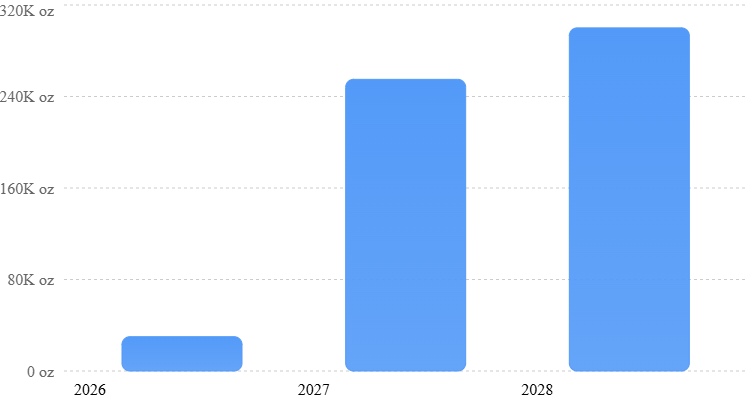
Company projections, not actual production. 2027 uses the midpoint of the forecast range.
For 2026, Kurmuk is expected to produce between 25,000 and 35,000 ounces. Production could then rise to between 240,000 and 270,000 ounces during 2027, before reaching approximately 300,000 ounces annually in 2028.
Over the mine’s entire operating life, Allied Gold anticipates average annual production of around 240,000 ounces.
These figures would place Kurmuk among Ethiopia’s most important industrial mining operations, demonstrating that the country has the potential to attract and sustain large-scale international investment in mineral extraction.
The $3.9 billion Chinese deal that never happened
The launch of gold production comes against the background of an ambitious Chinese acquisition that could have dramatically changed the ownership of Allied Gold’s African mining assets.
Earlier in 2026, Zijin Gold, part of China’s powerful Zijin mining group, pursued a takeover of Allied Gold valued at approximately C$5.5 billion, equivalent to roughly US$3.9 billion at the time of the announcement.
Had the transaction succeeded, the Chinese company would have gained control of Allied Gold’s mining interests across several African countries, including Mali, Côte d’Ivoire and Ethiopia.
The acquisition would have represented another major expansion of China’s already substantial involvement in African mineral resources.
However, the agreement was terminated after the parties concluded that the remaining conditions could not be satisfied within a reasonable timeframe.
The collapse did not mean that Zijin had abandoned its interest in Allied Gold.
Instead, the Chinese mining company agreed to invest approximately $295 million through a private placement, giving it a minority ownership position of around 9.2%, according to the reported terms.
The distinction is important. Rather than acquiring full control of Allied Gold and its African portfolio, Zijin would become a significant minority investor.
For Ethiopia, the episode illustrates how its mineral resources are becoming connected to a much larger international investment landscape.
Canadian mining expertise, Chinese capital and Ethiopian mineral deposits are increasingly intersecting within the same economic projects.
That is not necessarily a disadvantage. Foreign investment can provide financing, technology and access to international markets that would otherwise take many years to develop domestically.
But it also raises a fundamental question for Ethiopia and other African resource-producing countries: how much of the value generated by their minerals will remain within their own economies?
Hundreds of millions of dollars beneath Ethiopian soil
The potential financial value of Kurmuk’s production is considerable.
At an illustrative international gold price of $4,000 per ounce, annual production of 300,000 ounces would represent approximately $1.2 billion in gross gold value.
ILLUSTRATIVE ANNUAL GOLD VALUE AT FULL TARGET OUTPUT
$1.2 billion
300,000 ounces × $4,000 per ounce. Hypothetical gross value, not profit or Ethiopian government revenue.
The calculation is illustrative rather than a prediction of future revenue. Actual earnings will depend on international gold prices, production volumes, processing performance, operating costs and commercial arrangements.
Nevertheless, the scale of the opportunity is difficult to ignore.
Ethiopia has long faced shortages of foreign currency, complicating the importation of machinery, industrial equipment, medicines and other essential products. A substantial increase in formal gold exports could help diversify the country’s sources of hard currency.
The benefits could extend beyond the mine itself.
Industrial mining operations require electricity, roads, transport services, engineering, security, maintenance, accommodation and supplies. Local companies could benefit from contracts, while Ethiopian workers could gain access to specialised technical training and employment.
The development of a modern mining industry could also encourage further geological exploration, attracting investors interested in other deposits across the country.
Yet mining wealth does not automatically translate into national prosperity.
The experience of several resource-rich African economies demonstrates that large export revenues can coexist with poverty, environmental damage and limited domestic industrial development.
For Ethiopia, the challenge will be to ensure that mining investment strengthens the wider economy rather than creating isolated industrial enclaves whose principal purpose is exporting raw materials.
Can Ethiopia avoid Africa’s resource trap?
Africa possesses extraordinary mineral wealth, yet the continent has frequently struggled to capture the full economic benefits of its natural resources.
Gold, copper, cobalt, diamonds and other valuable commodities are extracted in enormous quantities, often with much of the processing, financing and commercial value concentrated outside the producing countries.
Ethiopia has an opportunity to approach its expanding mining industry differently.
A successful strategy would involve more than collecting royalties and taxes. It would require developing Ethiopian technical expertise, encouraging domestic suppliers, improving infrastructure and ensuring that communities surrounding mining operations receive meaningful economic benefits.
Environmental protection must also be central to that strategy.
Large-scale gold mining can require substantial water resources and careful management of processing chemicals and waste. Strong monitoring, transparent environmental standards and responsible rehabilitation plans are essential if the industry’s expansion is to remain sustainable.
The Kurmuk project could become an important test of Ethiopia’s ability to balance international investment with domestic economic interests.
There is also a regional dimension.
Western Ethiopia’s development is closely connected to infrastructure, security and trade across the wider Horn of Africa. Better transport networks, reliable electricity and stronger commercial connections could support economic activity far beyond the mining sector.
In a region too frequently characterised by political rivalry and conflict, economic cooperation offers a different path towards stability.
Mining investment cannot resolve the Horn’s political challenges by itself. But industries that create jobs, improve infrastructure and encourage cross-border commerce can provide powerful incentives for cooperation.
A golden opportunity Ethiopia cannot afford to waste
The first gold pour at Kurmuk is more than a technical achievement for a Canadian mining company. It represents another indication that Ethiopia’s economic potential extends far beyond its traditional agricultural foundations.
The country has already demonstrated its willingness to undertake ambitious infrastructure projects, particularly in electricity generation. Developing a competitive mining industry could become another important component of its long-term economic transformation.
But the next two years will be decisive.
Allied Gold must demonstrate that Kurmuk can achieve its production targets, maintain operational efficiency and deliver the output promised to investors. Ethiopian authorities, meanwhile, must ensure that the development contributes meaningfully to national revenue, employment and local economic opportunities.
The failed $3.9 billion Chinese takeover adds an intriguing dimension to the story, revealing the scale of international interest in African gold assets. Yet the ownership struggles of foreign mining companies should not overshadow the central issue.
Ethiopia is beginning to unlock mineral resources that could contribute significantly to its economic future.
Whether those resources ultimately generate lasting national wealth will depend not simply on how much gold comes out of the ground, but on what Ethiopia builds with the proceeds.
The gold is finally flowing. The real question is whether Ethiopia can turn this new gold rush into prosperity for its own people.