


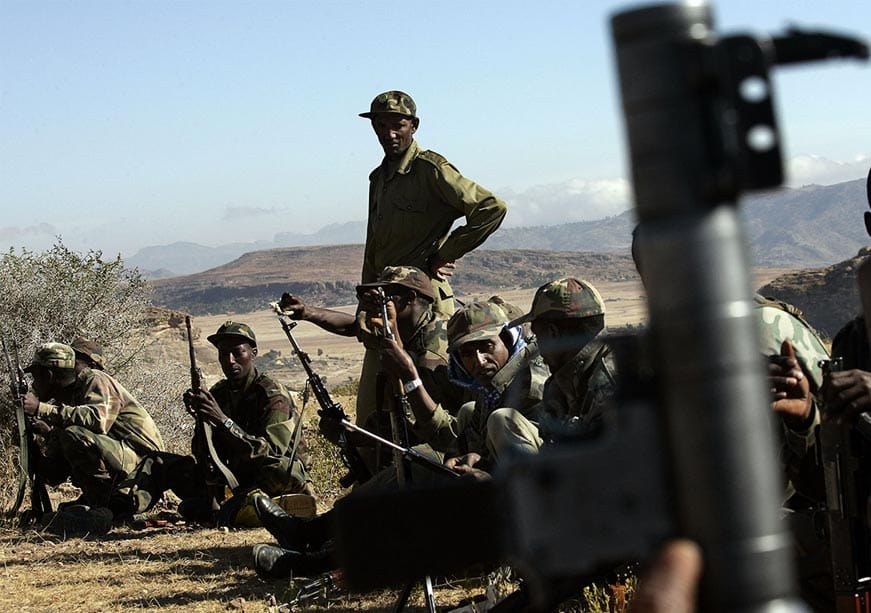
Ethiopia’s fragile peace is unraveling once again, and this time, the consequences could be catastrophic for the entire Horn of Africa. What started as an internal conflict is now threatening to explode into a regional war, dragging in neighboring countries and international powers.
The last major bloodshed began in November 2020, when the Ethiopian National Defense Force (ENDF) clashed with the powerful Tigray People’s Liberation Front (TPLF) and their allies, including the Oromo Liberation Army (OLA). That brutal conflict lasted nearly two years, claiming 600,000 lives and displacing close to a million Ethiopians. Despite a peace deal in March 2022, fighting resumed just months later. A second agreement, signed in November 2022, managed to hold – barely – until today.
But history seems ready to repeat itself. Except this time, former allies have turned into bitter rivals. Eritrea, which once fought alongside Ethiopia against the TPLF, has reportedly shifted sides, backing new rebel groups against Prime Minister Abiy Ahmed’s government.
Eritrea’s Betrayal: A Brewing Storm
To understand this dramatic turnaround, we must rewind. Eritrea, once an Italian colony, was annexed by Ethiopia in 1962, only to win its independence in 1993 after a grueling 30-year war. Relations remained tense until Abiy Ahmed came to power in 2018 and brokered a historic peace with Eritrean President Isaias Afwerki.
During Ethiopia’s war against the TPLF, Eritrean troops provided crucial support. But when Abiy unilaterally ended the conflict with the Pretoria Agreement in 2023 — without consulting Eritrea — resentment boiled over. President Afwerki publicly expressed his anger, calling the agreement “Tekolifna” — “we have been frustrated.”
Though the Pretoria deal required “withdrawal of foreign forces,” Eritrean troops remained inside Ethiopia, further straining relations. Now, as Ethiopia faces new rebellions from groups like Fano and remnants of the TPLF, Eritrea appears to be throwing its weight behind the insurgents.
Fano’s Uprising: Freedom Fighters or Agents of Chaos?
One of the most dangerous players in this new conflict is Fano, an ethno-nationalist militia claiming to defend the Amhara people. Their name harkens back to Ethiopia’s anti-fascist fighters of the 1930s, but today’s Fano is less romantic: heavily armed, angry, and feeling betrayed by the Pretoria Agreement, which called for the disbandment of all regional forces.
Fano leaders argue that disarmament would leave Amhara vulnerable to attacks from rival regions like Tigray and Oromia. In response, they took up arms against the government in April 2023 — and have only grown stronger since.
Meanwhile, the Tigray region itself has fractured. A split between the Tigray Interim Administration and the TPLF’s hardline faction, led by Debretsion Gebremichael, has led to renewed instability. Debretsion’s forces recently toppled the interim president appointed by Addis Ababa, raising fears of a fresh alliance with Eritrea to strike back at the Ethiopian state.
The Red Sea Gamble: A Dangerous Game of Ports and Power
In a bold and risky move, Prime Minister Abiy Ahmed announced plans in early 2024 to secure access to the Red Sea — a centuries-old Ethiopian dream — by signing an agreement with Somaliland, a breakaway region of Somalia. The deal enraged Eritrea, Somalia, and Egypt, all of whom see Ethiopia’s move as a dangerous escalation.
In response, Eritrea inked a security pact with Egypt and Somalia, raising fears of a broader anti-Ethiopian coalition. Ethiopian troops have since massed near the Eritrean border, and Eritrea has launched a nationwide military mobilization. The powder keg is ready. One spark could ignite a devastating regional war.
Middle Eastern Powers Circle the Horn
The Horn of Africa is too strategic for the world to ignore. The United Arab Emirates and Türkiye have invested heavily in the region, and they will not stand idly by if chaos threatens their interests. Egypt, meanwhile, sees a weakened Ethiopia as an opportunity — especially in their ongoing battle over the Nile’s waters and the Grand Ethiopian Renaissance Dam.
But a broader conflict would be disastrous for everyone. Disruption of Red Sea trade would hammer Egypt’s economy, reliant on the Suez Canal. Saudi Arabia and the Gulf states would see vital shipping routes imperiled. Instability could ripple from the Sahel across to the Arabian Peninsula.
The Horn Teeters on the Brink
Unlike the last round of conflict, today’s rebel groups are far better armed, with Fano reportedly wielding heavy artillery and advanced weaponry. Meanwhile, external powers are more deeply entangled. If outside actors begin funneling weapons and support to rival groups, Ethiopia could collapse into a Balkan-style nightmare of endless proxy wars.
The signs are already there: Sudan teetering on the edge, Chad battling insurgencies, and a corridor of chaos stretching from West Africa to the Red Sea.
The world cannot afford another civil war in the Horn of Africa. But unless urgent action is taken to de-escalate tensions between Ethiopia and Eritrea, and unless a broader peace framework is brokered that includes all regional actors, a devastating new conflict seems inevitable.
The clock is ticking. And if history is any guide, the Horn of Africa may once again be consumed by a war far bloodier than the last.